

Turning fragmented frontline observations into global, action-ready evidence for tech policy and community protection.
The problem
The organizations and families who see the harm first have firsthand knowledge, but it sits in interviews, case notes and conversations, in formats that cannot be compared. Small organizations rarely have the capacity to turn it into evidence, and those who share information seldom get anything useful back.
So each case is often dealt with locally, and the people handling it often have no easy way to see that the same harm has already happened somewhere else or what they can learn from how others faced the same issue.
What FARO is and how it works
FARO brings documented cases together, removes identifying details, and links them across countries so that patterns invisible in a single case become visible. Organizations that contribute get something back: a view of whether what they see is local or part of a wider pattern. Contributors keep ownership of what they share, and contributor data is not used to train AI models.
Accounts arrive through forms, interviews and partner organizations. Daily searches also gather public records: court cases, regulator decisions, news and research
Each incident is reduced to what happened, with names and identifying details removed.
A pattern is a way technology in ordinary use produces harm that recurs across countries. Differing responses to incidents are also compared and analyzed.
“In Zimbabwe it is always a challenge getting a critical mass of statements about harms that we are seeing in our communities. The FARO approach of combining what we are seeing with other countries helps us fill that gap so we are in a better position to push for safer technology in our country.”
Edith Utete, Digital Wellness Africa, Zimbabwe
"Showing Kenyan experiences alongside cases from Zimbabwe, India, Italy, Norway, Turkey, and other countries demonstrates that these are systemic issues rather than isolated incidents. The country guide avoids sensationalism and instead encourages documentation and reporting."
Evelyn Kasina, Eveminet Communications Solutions Limited, Kenya
Campaign 1 · Report 001
A look at how technology used in an educational setting has harmed members of school communities around the globe, analyzing similar patterns across many countries.
Children, families and school staff were harmed by technology their schools supplied, required or chose. In the records, which come from countries on every continent and include accounts told directly to SHIELD and its partners, the harm took four forms: children reached pornography on school-issued devices, required products collected children’s data with no way to opt out, school chats and images were used to expose or hurt students and teachers, and schoolwork could only be done on a product that families or staff had to pay for. The same thing happened under different laws and in different school systems. In some cases, students were expelled or suspended after videos of their assault or private images were shared. Most responses came after the harm was found, as fines, reprimands, investigations and lawsuits, and in a smaller group the school kept the product in use or the consequence fell on the person harmed. Much of the record comes from a handful of countries, and in many others a single report is the only source, so there is little regular collection of accounts on this problem.
MAIN RECOMMENDATION:
Whenever a regulator, ministry or court decides a case about a school product, it should publish what the product was, what failed and what was required. Governments and funders that support school technology should pay for regular collection of accounts from pupils, families and teachers, so a school or family facing harm can look up what has already been found and done elsewhere.
Campaign 2 · Report 002
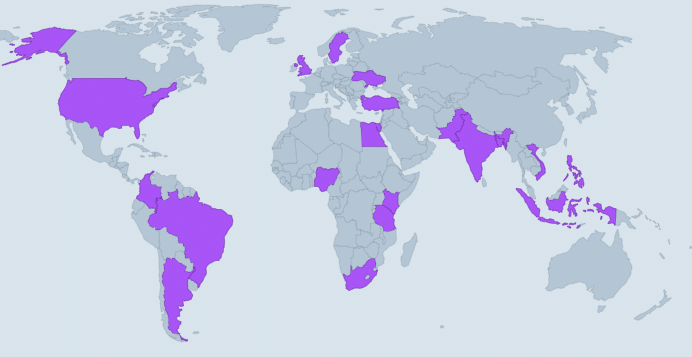
People who label data, train AI models and take freelance work online depend on platforms and payment companies to receive their pay. In the records, including accounts told directly to the Data Labelers Association (DLA) in Kenya, pay for work that was done and accepted still failed to reach the worker in five ways: the payment account holding it was frozen, the pay was cut after the work was done, the account was banned and the pay kept, training work went unpaid, or a platform change left no way to submit an invoice or receive the pay. The same thing happened on different platforms and under different laws. In Kenya, DLA’s leaders described balances held for 60 and 180 days, and research describes workers losing money meant for medical bills, rent and a newborn’s savings. Of the 60 responses recorded, 51 left the problem in place or put it back on the worker. Most accounts of unpaid or withheld pay come from complaints to the Better Business Bureau, which record no country, so there is little regular collection of accounts on this problem.
MAIN RECOMMENDATION:
Whenever pay for completed work is held, cut or cannot be submitted, the company that controls it should name who is responsible and give a date for an answer. Platforms and payment companies should collaborate to ease checks for workers the platform has already verified.
incident directory
Each one describes a specific person, a specific technology and something that happened, and links to its source with the date the link was last checked. Records come from court cases, regulator decisions, news reports, research, personal posts and accounts given directly to SHIELD and its partners, and each shows which of these it is.
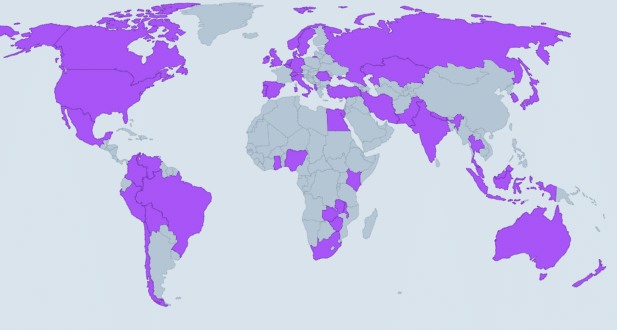
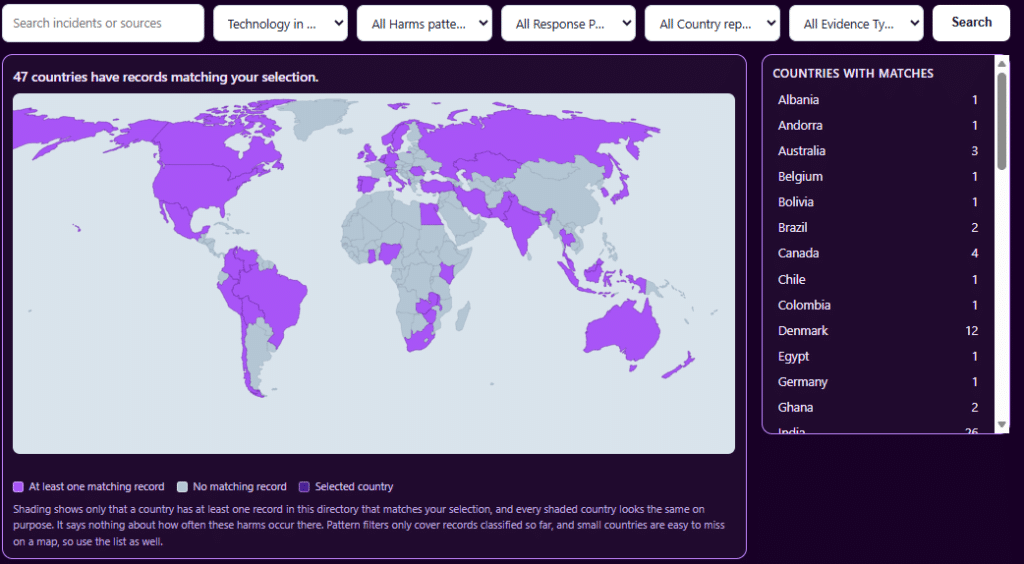
Choose a topic, then a harm pattern, and the map shows which countries have matching records. Open a country to read the records. You can also filter by country report or evidence type, or search.
Data Integrity & Methodology
FARO shows when and how harm happens, but it does not show how often. A country with many records has more published about it, and a country with few may have little published, so counts reflect what could be found and shared, and the shading on the map only means a country has at least one matching record.
The records are accounts, and most have not been ruled on by a court or regulator. FARO does not check individual accounts or decide individual cases. The recommendations in the reports are SHIELD’s own, drawn from what the records show.
Take Part
Accounts shared with FARO are not sold, and names and any details that could identify a person are removed before any part of a record is published. You can also share an account without giving a name.
Before deciding how to respond to a harm, look it up in the directory to see what others have found and done.
Support regular collection in the countries where the least is published, so the record covers more places.
Funding and acknowledgments
The first two FARO campaigns and reports were funded by NetHope through its Connected AI Grants. The findings and views in the reports are those of SHIELD-APS and do not necessarily reflect the views of NetHope.
We thank the local partners listed under each campaign for collecting and sharing accounts, and Internet Safety Labs for research and taxonomy support. FARO’s harm classification builds on Internet Safety Labs’ Digital Harms Dictionary.
About FARO
FARO is stewarded by SHIELD-APS, a nonprofit registered in Italy that works on online safety, responsible AI and child protection.